
Introduction
Python Free Download for Windows 11 gives developers, students, data analysts, researchers, and automation enthusiasts access to one of the world’s most widely used programming languages. Python is an open-source, high-level programming language designed to make software development readable, practical, and relatively easy to learn.
Python was originally created by Guido van Rossum and is now developed and maintained by the global Python community under the guidance of the Python Software Foundation (PSF). The official project is distributed under the Python Software Foundation License and is free to use, including for commercial purposes.
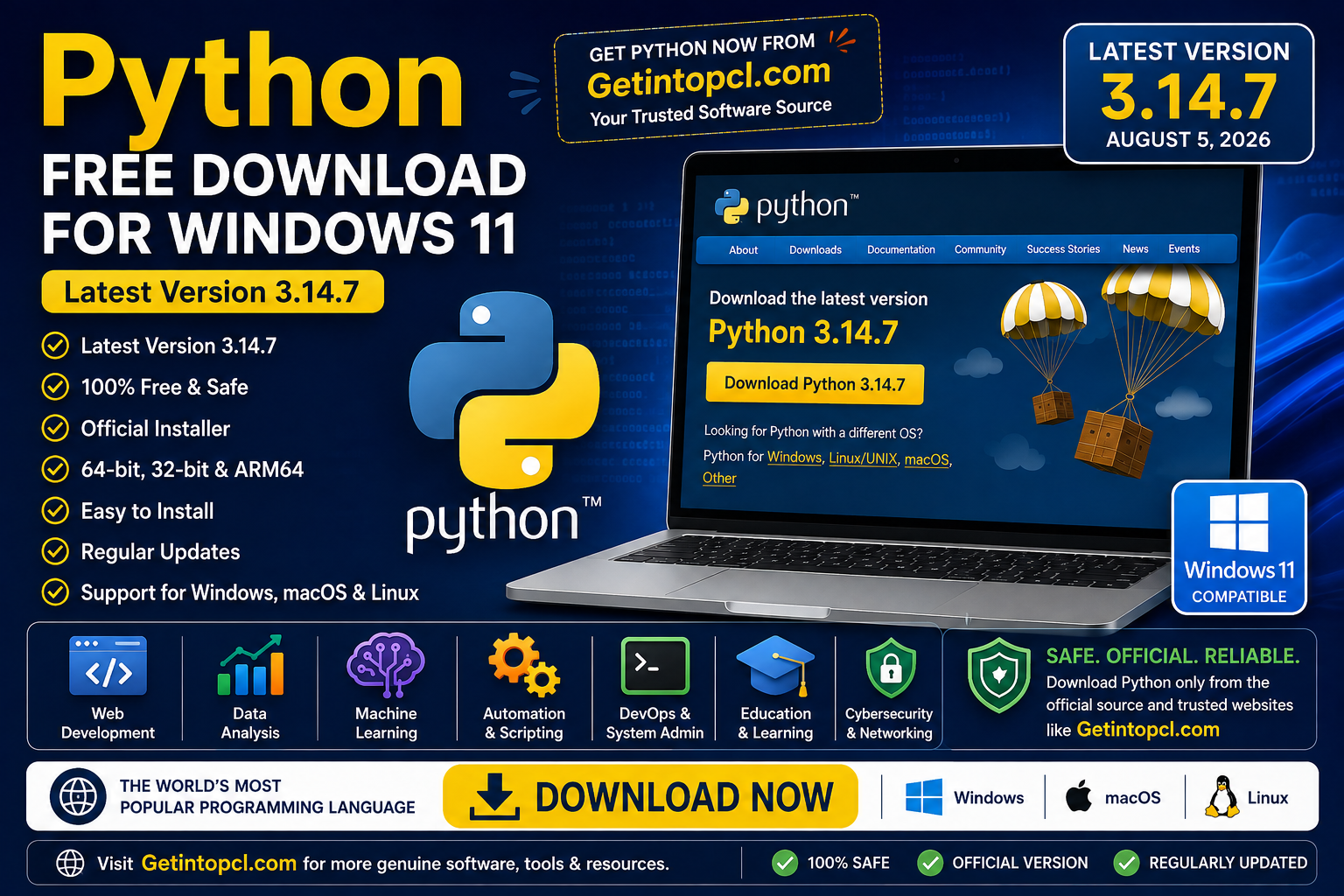
As of August 2026, the latest stable Python 3 release for Windows is Python 3.14.7, released on August 5, 2026. The official Windows download page also provides installers for 64-bit, 32-bit, and ARM64 systems.
Python can be used for web development, automation, artificial intelligence, machine learning, scientific computing, data analysis, desktop applications, networking, education, scripting, and many other tasks.
What Is Python Used For?
Python is more than a basic programming language. Its large ecosystem of libraries and frameworks allows developers to build different types of applications without having to create every component from scratch.
Some of its major uses include:
- Web development: Frameworks such as Django and Flask can be used to build websites and web applications.
- Data analysis: Python is widely used for processing, analyzing, and visualizing data.
- Artificial intelligence: Developers use Python for AI and machine-learning projects.
- Automation: Python scripts can automate repetitive computer tasks.
- Scientific computing: Researchers can use Python for calculations, simulations, and experiments.
- Education: Its relatively readable syntax makes it popular for teaching programming.
- Desktop applications: Python supports graphical user-interface development.
- Networking: Python provides libraries for network programming and internet-related applications.
- Software development: Developers can create utilities, applications, tools, and prototypes with Python.
Key Features of Python
Python’s popularity comes from a combination of simple syntax, extensive libraries, portability, and a large developer community.
Easy-to-Read Syntax
Python was designed with readability in mind. Its syntax generally requires less code than many traditional programming languages, making it approachable for beginners while remaining powerful enough for professional developers.
Large Standard Library
Python includes a substantial standard library covering areas such as file handling, mathematics, networking, data formats, operating-system interaction, testing, and more.
Huge Package Ecosystem
Developers can install thousands of additional packages through the Python Package Index (PyPI). This allows Python to be extended for specialized requirements such as data science, machine learning, web development, and scientific research.
Cross-Platform Support
Python is not limited to Windows. Official Python distributions are available for Windows and macOS, while Python is also widely available through Linux distribution repositories and can be built from source.
Interactive Interpreter
Python can be used interactively from a command line, allowing users to test commands and small pieces of code without creating a complete program.
IDLE
The standard Python distribution includes IDLE, a basic development environment and Python shell. It can be useful for beginners who want a simple environment for writing and testing Python programs.
Virtual Environments
Python supports isolated environments, allowing different projects to use their own package configurations and dependencies. This is particularly useful for professional development.
Python 3.14.7 for Windows 11
For users looking for the Python latest version, Python 3.14.7 is currently the latest stable Python 3 release listed by Python.org. It was released on August 5, 2026.
Python 3.14 supports Windows 10 and newer, which means Windows 11 is fully within the supported Windows range. Python’s documentation states that users requiring Windows 7 should use Python 3.8, while Windows 8.1 users should use Python 3.12.
Python 3.14 Windows downloads are available for:
- 64-bit Windows
- 32-bit Windows
- ARM64 Windows
The current Windows distribution is moving toward the Python Install Manager, although traditional installers remain available during the Python 3.14 and 3.15 release periods.
Python System Requirements
Python does not publish a conventional minimum RAM, processor, graphics-card, or disk-space specification for normal desktop use in the way that commercial applications often do. Therefore, it would be misleading to invent exact minimum figures.
The following table distinguishes official platform information from practical considerations:
| Requirement | Minimum / Official Information | Recommended |
|---|---|---|
| Operating System | Python 3.14 supports Windows 10 and newer | Windows 11 64-bit |
| Processor | No specific CPU minimum published by Python | Modern 64-bit Intel/AMD or compatible ARM64 CPU |
| RAM | No official minimum RAM figure published | 4 GB or more for comfortable general development |
| Storage | No official fixed storage requirement published | Keep several GB available for Python, packages, projects, and caches |
| Graphics | No dedicated GPU required for Python itself | Integrated graphics is sufficient for normal Python development |
| Internet | Not required to execute already-installed Python programs | Internet recommended for downloading packages, updates, and documentation |
| Architecture | Windows 64-bit, 32-bit, and ARM64 packages are available | 64-bit for most modern Windows 11 PCs |
| Additional software | Python distribution includes its core runtime and standard tools | A code editor/IDE and virtual environments can improve development |
The recommended figures above are practical guidance rather than official Python minimum specifications. Hardware requirements can also increase considerably when Python is used with large datasets, AI models, scientific workloads, or resource-intensive third-party packages.
Windows, macOS, and Linux Compatibility
Windows
Python 3.14 supports Windows 10 and newer, making it suitable for Windows 11 systems. Official downloads include different architectures, so users should choose the installer that matches their computer.
Older Windows versions have limitations. Python 3.14 does not support Windows 7 or Windows 8.1. Users requiring Windows 7 support need an older Python release such as Python 3.8, while Windows 8.1 users should use Python 3.12.
macOS
Python is also available for Mac. Current official Python installers are universal2 builds that can run natively on supported Intel and Apple Silicon Macs. Python’s documentation says current installers typically support macOS 10.15 Catalina and newer.
Users should check the release documentation for the exact macOS compatibility of the version they intend to install.
Linux
Python is available on virtually all major Linux distributions. Many distributions include Python in their repositories, although the packaged version may not always be the newest release. Users who need the latest Python can compile it from source or use an appropriate distribution/package-management method.
Is Python Free or Paid?
Python is completely free and open source. It is not a subscription product, freemium application, or paid commercial program.
The Python Software Foundation states that Python is distributed free of charge, and Python’s licensing permits commercial use.
There is therefore no official “Python Premium” or “Python Pro” edition that users must purchase.
| Version / Option | Price | Main Features |
| Official Python | Free | Full Python interpreter, standard library, IDLE and standard tools |
| Python Install Manager | Free | Installs and manages Python versions on Windows |
| Python packages | Usually free/open source | Additional functionality through the Python ecosystem |
| Commercial third-party distributions | Varies | May provide additional tools, support, or enterprise services |
It is important to distinguish Python itself from third-party products that use Python. Some development tools, IDEs, cloud services, or commercial Python distributions may have paid editions, but those are separate products.
Where to Safely Download Python
The safest option is the official Python website. The Python.org download pages provide current Windows releases, macOS installers, source releases, and information for other platforms.
For Windows users, the official release files are digitally signed by the Python Software Foundation, providing an additional way to verify that downloaded Windows binaries are genuine. Python also provides information about Sigstore verification for supported release artifacts.
For Windows specifically:
Avoid downloading modified installers, cracked versions, activation tools, or unknown executable files from unauthorized websites. Python itself is already free, so there is no legitimate reason to use a “cracked” version.
Advantages of Python
- Free and open source.
- Works across major operating systems.
- Beginner-friendly syntax.
- Large standard library.
- Huge third-party package ecosystem.
- Excellent for automation and scripting.
- Widely used in AI, data science, and web development.
- Strong community and extensive documentation.
- Suitable for both learning and professional development.
- Can be used commercially without purchasing a Python license.
Limitations of Python
- Python can be slower than compiled languages for certain CPU-intensive workloads.
- Large third-party packages can consume significant storage.
- Managing multiple environments and dependencies can become complicated in larger projects.
- Some advanced applications may require knowledge of additional tools and programming concepts.
- Python itself does not provide a complete professional IDE; developers may choose separate editors or IDEs.
- Hardware requirements can become much higher when using demanding AI, scientific, or data-processing packages.
Who Is Python Best Suited For?
Python is suitable for a broad range of users.
Beginners can use it to learn programming because the syntax is relatively straightforward. Students can use Python for coursework and programming projects. Developers can use it for web applications, automation, software tools, and APIs.
It is also particularly valuable for data analysts, scientists, researchers, DevOps professionals, cybersecurity specialists, and AI developers because of the extensive ecosystem surrounding the language.
Users working with machine learning or large datasets should remember that Python itself may be lightweight, while the libraries and workloads they install can require substantially more RAM, storage, or GPU resources.
Frequently Asked Questions
1. Is Python free to download?
Yes. The Python download for Windows 11 is free and open source. The Python Software Foundation distributes Python free of charge, and its license permits commercial use.
2. Is Python 3.14.7 compatible with Windows 11?
Yes. Python 3.14 supports Windows 10 and newer, so Windows 11 is supported.
3. How much RAM does Python need?
Python does not publish a fixed minimum RAM requirement for normal installation. Basic scripts can run on relatively modest hardware, while demanding applications such as machine learning and large-scale data processing can require substantially more RAM.
4. How much storage space does Python require?
There is no single official minimum storage specification for a normal Python installation. The required space depends on the installation and the additional packages and projects you use. Keeping several GB free is a sensible practical choice for development.
5. Does Python work on Mac?
Yes. Official Python installers are available for macOS, including universal2 builds for supported Intel and Apple Silicon Macs.
6. Does Python work on Linux?
Yes. Python is available through repositories on major Linux distributions, and users can also build newer versions from source when necessary.
7. Is there a premium version of Python?
No. There is no official premium version of Python. The Python programming language itself is free and open source. Some third-party Python tools or distributions may offer paid services, but they are separate from Python itself.
8. Where should I download Python?
For maximum safety, download it directly from Python.org. Official Windows releases are signed by the Python Software Foundation, providing a method to verify their authenticity.
Conclusion
Python remains one of the most useful free programming platforms for Windows 11 users. The current stable Python 3 release, Python 3.14.7, supports Windows 10 and newer and is therefore a strong choice for Windows 11 users. It is also available for macOS and Linux, making it practical for developers who work across multiple operating systems.
Because Python is already free and open source, users should prioritize official, unmodified downloads rather than cracked or unauthorized packages. If you need Python or other legitimate software for your PC, always check the developer’s official source first. For additional software resources, you can also explore GetIntoPCL and verify that any software you download is legitimate and properly licensed.
Important: The safest download for Python is the official Python.org release.