
Pieces AI is a developer-focused AI productivity platform designed to help programmers save, understand, search, and reuse information from their development workflow. Rather than functioning only as a conventional coding chatbot, Pieces combines AI assistance with long-term memory, code-snippet management, contextual search, notes, screenshots, and integrations with development tools.
The platform is built by Pieces, a software company focused on AI-assisted developer productivity. Its current product architecture combines a desktop application, PiecesOS as a local background service, and integrations that connect Pieces with IDEs, browsers, and other applications.
For developers searching for an AI coding assistant with memory, AI developer tools, code snippet manager, local AI assistant, developer productivity software, or AI tool for VS Code and JetBrains, Pieces provides a workflow centered on preserving context instead of treating every AI conversation as a completely new session.
A particularly important aspect is its local-first architecture. Pieces says its memories are stored on the user’s device by default, while cloud functionality and third-party AI models can be enabled when needed.
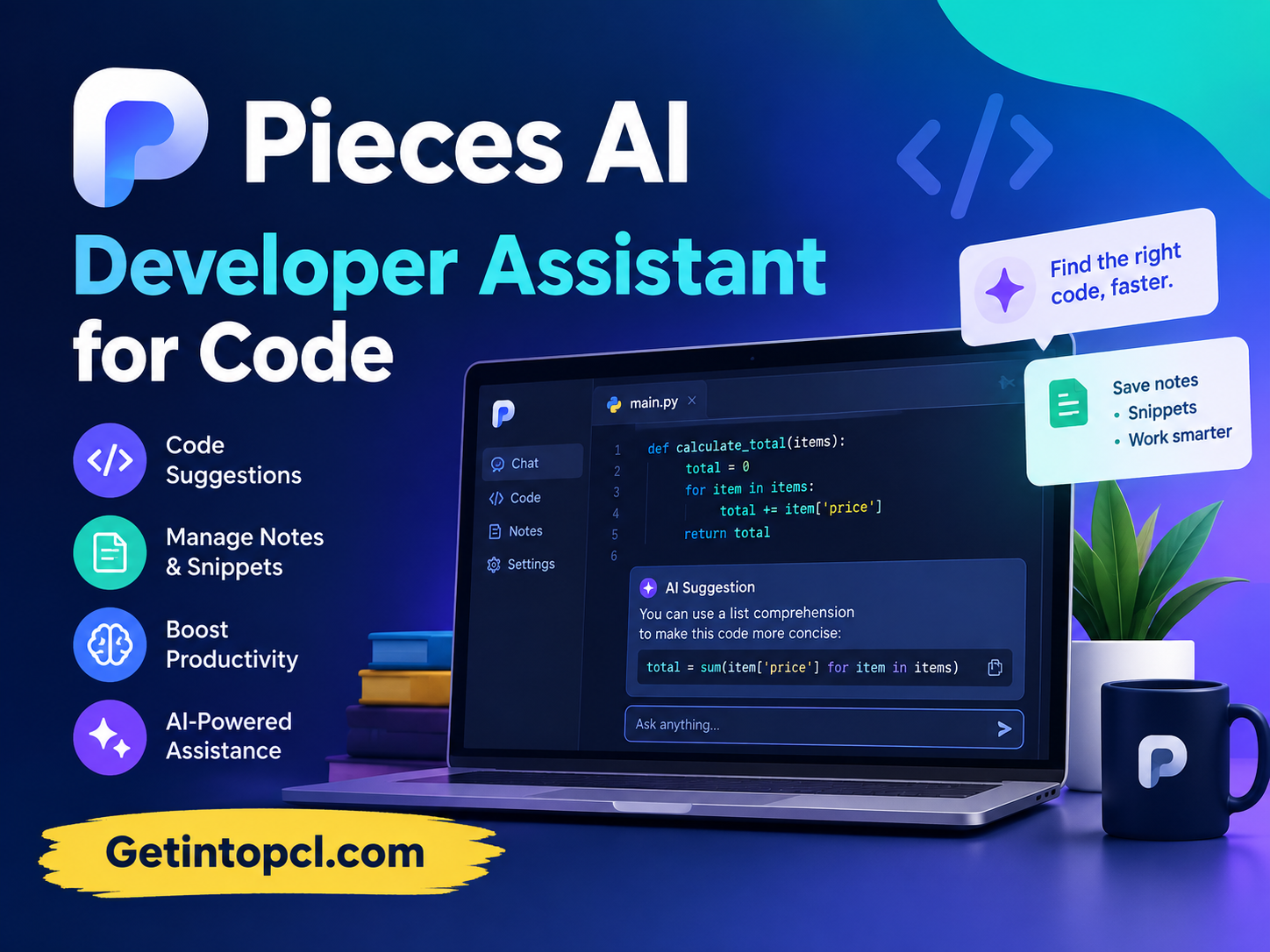
What Is Pieces AI?
Pieces AI is the AI-powered assistance layer within the broader Pieces developer platform. It can help developers work with code, snippets, screenshots, files, notes, research, and other information accumulated during software development.
The platform consists of several connected components. Pieces for Developers provides the desktop interface for managing saved materials, while PiecesOS runs in the background and provides the local services required by Pieces and its integrations.
The current Pieces documentation describes the platform as three layers:
- Desktop App: Search history, ask questions, and manage memories.
- PiecesOS: Local background service and AI/memory engine.
- Integrations: Connections with IDEs, browsers, AI assistants, and other tools.
This architecture allows Pieces to retain context across different parts of a developer’s workflow. For example, information researched in a browser can later be connected with code being edited in an IDE.
Pieces is therefore more than a standalone AI chatbot. It combines:
- AI coding assistance
- Long-term memory
- Code snippet management
- Developer notes
- Contextual search
- Screenshot and visual understanding
- IDE integrations
- Browser integrations
- Local AI processing
- Cloud AI model support
- MCP integration
Main Uses of Pieces AI
AI Coding Assistance
Pieces Copilot can assist with programming-related tasks such as generating code, explaining code, adding comments, troubleshooting problems, and working with project context.
The Pieces VS Code extension, for example, allows users to interact with Pieces Copilot directly inside VS Code and compatible VS Code-based editors such as Cursor. Users can provide files and folders as context when asking coding questions.
This can be useful for tasks such as:
- Explaining unfamiliar functions
- Generating code examples
- Debugging
- Refactoring
- Adding comments
- Understanding existing projects
- Reviewing sections of code
- Finding previously saved solutions
Code Snippet Management
Pieces began with a strong focus on saving and reusing useful code snippets.
Developers can save code from websites, IDEs, screenshots, and other sources and organize it inside Pieces. The platform can enrich saved snippets with additional context and make them easier to search and reuse.
This is useful for developers who frequently reuse:
- API examples
- SQL queries
- Shell commands
- Configuration files
- HTML templates
- CSS patterns
- JavaScript functions
- Python utilities
- Regular expressions
- Debugging solutions
Developer Notes and Knowledge Management
Pieces can act as a personal knowledge layer for development work. Instead of keeping useful information scattered across browser bookmarks, chat conversations, documents, and different projects, users can preserve relevant information and search for it later.
Its long-term memory system is designed to connect information based on the user’s workflow and timeline.
Research and Problem Solving
Developers frequently move between documentation, search engines, GitHub, forums, AI assistants, and their IDE while solving a problem.
Pieces is designed to preserve parts of this research process. Its current product description includes browser research, source trails, chats, notes, and project context among the information that can become part of its searchable memory.
This means a developer can potentially return to a previous research trail without manually remembering which website, conversation, or project contained the information.
Working With Screenshots
Pieces can extract and work with information from screenshots, including code and text. Its Copilot has supported multimodal interactions in which users can start a coding discussion from an image containing code or text.
This can be useful when a developer encounters code inside:
- Screenshots
- Error messages
- Documentation images
- Chat conversations
- Tutorials
- Design references
Cross-Tool Context
One of Pieces’ central ideas is maintaining context when developers move between applications.
The current platform supports integrations with tools such as VS Code, JetBrains, Chrome, Cursor, Claude, Codex, Perplexity, GitHub Copilot, and other applications.
Features
AI Coding Copilot
Pieces Copilot provides AI assistance for coding and developer questions. It can generate, explain, troubleshoot, and transform code while using available project or workflow context.
Long-Term Memory
Long-Term Memory is one of the defining features of the current Pieces platform. PiecesOS can capture and organize contextual information from supported applications so users can later search or ask questions about previous work.
Pieces Drive
Pieces Drive is the platform’s personal library for saved snippets and other developer materials. It allows users to organize and reuse information rather than repeatedly searching for the same code.
Semantic and Contextual Search
Pieces can help users find previous work based on context rather than relying exclusively on remembering the original filename or location. The platform’s current product pages describe searching across topics, time, sources, and workflow history.
IDE Integrations
Pieces provides extensions and plugins for development environments including VS Code and JetBrains IDEs. Its VS Code integration provides access to Pieces Drive and Pieces Copilot inside the editor.
Browser Extensions
Pieces provides integrations for Chromium-based browsers and other supported browsers. Users can save useful code and research material directly from their browsing workflow.
Local AI Processing
PiecesOS supports local AI processing. Its settings allow users to configure blended processing using local and cloud models or switch to local processing where supported.
Cloud AI Models
Users can also use supported cloud-based AI models. This provides an alternative when a particular task requires a model that is not being run locally.
MCP Support
Pieces provides an MCP server that can pass workflow context into compatible AI assistants and development environments. The current product site lists integrations with tools including Claude, Cursor, Codex, Antigravity, and other MCP-ready assistants.
Privacy Controls
Pieces says memories are stored locally by default. Users can pause long-term memory, disable capture from particular applications or websites, and delete information from selected sources or periods.
Platform and Compatibility
Pieces supports the major desktop operating systems used by developers.
| Platform | Availability |
|---|---|
| Windows | Yes |
| macOS | Yes |
| Linux | Yes |
| Android | Not listed as a primary desktop product |
| iOS | Not listed as a primary desktop product |
| Web | Browser extensions and integrations available |
Pieces’ official website currently provides downloads for Windows, macOS, and Linux.
Linux users can run PiecesOS and access Pieces Copilot and Pieces Drive through supported plugins and extensions, although the Linux Quick Menu currently provides fewer controls than the macOS and Windows versions.
Pieces also provides integrations for development and productivity applications, including VS Code, JetBrains IDEs, Chrome, Raycast, Obsidian, and Microsoft Teams.
System Requirements
Pieces provides platform-specific requirements through its documentation, but the company does not publish one universal CPU, RAM, GPU, and storage specification that applies to every Pieces configuration and AI model.
For macOS, current Pieces documentation identifies macOS 13 Ventura or later for the PiecesOS installation described in its integration documentation and supports both Apple Silicon and Intel architectures.
For Windows and Linux, Pieces provides official desktop downloads, but requirements can depend on the operating system version, PiecesOS version, integrations, and AI processing configuration.
A general setup therefore requires:
- A supported Windows, macOS, or Linux system
- Sufficient storage for the application and locally stored Pieces data
- Internet access for cloud-connected features and third-party cloud AI models
- Additional computing resources when using local AI models
- Required permissions for features that capture screen or application context
Pieces does not require a dedicated GPU for every use case. However, local AI model performance and hardware requirements can vary according to the model and configuration.
Technical Setup Details
Pieces uses PiecesOS as an important background component. It provides local services that allow the desktop application and integrations to communicate and enables the platform’s memory functionality.
A typical installation process is:
- Download Pieces from the official Pieces website.
- Install PiecesOS and the Pieces desktop application.
- Sign in when required.
- Enable Long-Term Memory if you want contextual workflow capture.
- Install the appropriate IDE or browser extensions.
- Configure which applications can contribute information to your memory.
- Choose local, blended, or cloud AI processing where supported.
- Start saving and searching code, notes, and other development material.
The Long-Term Memory controls allow users to disable specific sources. Pieces documentation also explains that captured information is stored locally by default and that cloud functionality can be enabled separately.
Users should review capture permissions carefully, particularly on machines that contain confidential source code, credentials, customer information, or private communications.
Pricing and Licensing
Pieces’ current product website presents the newer Pieces platform as a 7-day free trial followed by $18.99 per month for the individual plan. However, Pieces’ older developer documentation still contains pages describing Pieces for Developers as completely free. This reflects a transition in the product and pricing information, so users should check the current pricing page before subscribing.
| Offering | Current information |
|---|---|
| Pieces platform | 7-day trial, then $18.99/month currently displayed |
| Older Pieces for Developers documentation | Describes the earlier developer product as free |
| Enterprise | Separate team and enterprise offering |
| Local AI | Available as part of supported Pieces configurations |
The current website requires a card for the 7-day trial and states that users can cancel at any time.
Because Pieces is actively evolving its product structure, older articles or documentation pages may describe previous pricing models. Users should rely on the current official pricing information when making a purchase decision.
Advantages and Limitations
Advantages
- Combines AI assistance with long-term developer memory.
- Supports Windows, macOS, and Linux.
- Provides code snippet management through Pieces Drive.
- Integrates with popular IDEs and developer tools.
- Can preserve research and workflow context across applications.
- Supports local AI processing.
- Provides cloud AI model options.
- Offers controls over which applications contribute to memory.
- Supports MCP for connecting context to compatible AI assistants.
Limitations
- The platform can capture substantial amounts of workflow context, so privacy settings require careful attention.
- Some advanced functionality depends on cloud AI models or connected services.
- Local AI performance varies according to the selected model and computer hardware.
- The product and pricing structure has changed over time, making older documentation potentially misleading.
- Developers who only want basic code completion may not need the broader memory and workflow features.
- Linux functionality can differ from the Windows and macOS experience.
Who Should Use Pieces AI?
Software developers are the primary audience for Pieces. Its tools are designed around coding, research, snippets, debugging, and developer workflow management.
Students learning programming can use Pieces to save examples, explanations, exercises, and useful code for later reference.
Freelance developers can use separate snippet collections and contextual memory across different projects.
Software teams can use Pieces integrations and shared workflows for collaboration, although enterprise capabilities depend on the applicable product and plan.
Developers interested in local AI may find its local processing options relevant when they want AI functionality that can operate without sending all processing to a cloud service.
Pieces AI Alternatives
Pieces overlaps with several categories of developer tools, but the alternatives emphasize different functions.
GitHub Copilot focuses heavily on AI-assisted coding within development environments, including code generation and agentic workflows.
Cursor is an AI-powered code editor that integrates AI deeply into the coding environment.
Claude Code provides an agentic coding workflow centered around Claude and software development tasks.
Continue provides an open-source AI coding assistant that can connect developers with different models and development environments.
Ollama focuses primarily on running AI models locally rather than providing a complete developer memory platform.
Pieces differs from these tools by emphasizing long-term memory and cross-application context alongside coding assistance. Its current product connects information from development tools, browsers, AI assistants, chats, documents, and other sources into a broader workflow memory.
Download, Installation, or Access
Pieces can be obtained through its official website. The company currently provides downloads for Windows, macOS, and Linux.
Official Pieces website: pieces.app
Official developer platform: Pieces for Developers
Users should download Pieces and PiecesOS from the official Pieces website rather than using modified installers or unofficial copies.
For integrations, users can install supported extensions and plugins from the appropriate official extension marketplaces. Pieces provides integrations for VS Code, JetBrains, browsers, Raycast, Obsidian, and other tools.
Frequently Asked Questions
Is Pieces AI free?
Pieces’ current website presents a 7-day trial followed by a paid individual subscription, while older Pieces for Developers documentation still describes the earlier product as free. Because the product and pricing structure has changed, users should check the current official pricing information before subscribing.
What is Pieces AI used for?
Pieces is designed for developer productivity, including AI coding assistance, code snippet management, long-term memory, contextual search, research recall, and integrations with IDEs and other applications.
Does Pieces AI work on Windows?
Yes. Pieces provides a Windows desktop application and PiecesOS. The company also provides Windows-specific integrations and extensions.
Does Pieces AI work on Mac?
Yes. Pieces supports macOS and provides PiecesOS for Apple Silicon and Intel-based Macs in its documented configurations.
Does Pieces AI work on Linux?
Yes. Pieces provides Linux downloads. PiecesOS and supported integrations can provide access to Pieces Copilot and Pieces Drive on Linux, although some PiecesOS interface functionality is more limited than on Windows and macOS.
Can Pieces AI run locally?
Yes. Pieces is built around an on-device architecture, and PiecesOS provides local AI processing options. Users can also configure blended processing involving local and cloud models.
Does Pieces AI work with VS Code?
Yes. The Pieces VS Code extension provides access to Pieces Drive and Pieces Copilot directly inside VS Code and compatible VS Code-based editors such as Cursor.
Does Pieces AI replace GitHub Copilot?
Pieces and GitHub Copilot can be used together. Pieces focuses strongly on long-term workflow context and memory, while GitHub Copilot provides AI-assisted coding and agentic development features. Pieces itself describes the two tools as complementary in developer workflows.
Conclusion
Pieces AI is a developer-focused AI assistant that combines coding assistance, code snippet management, long-term memory, contextual search, and workflow integrations. Instead of limiting AI assistance to the files currently open in an IDE, Pieces is designed to connect information across a developer’s broader working environment.
Its architecture is built around PiecesOS, a local background service that powers the desktop application, integrations, and memory capabilities. Users can configure local or cloud AI processing, while Pieces provides controls for managing which applications contribute to captured context.
The platform supports Windows, macOS, and Linux and integrates with development environments such as VS Code and JetBrains, along with browsers and other productivity applications.
For developers searching for an AI coding assistant with memory, local AI developer software, code snippet manager, or AI productivity tool for programming, Pieces offers a workflow focused not only on generating code but also on remembering the research, notes, snippets, and context surrounding that code.
Because Pieces has changed its product structure and pricing over time, users should verify current plans, features, and system requirements on the official website before installing or subscribing.