
GitHub Copilot is an AI coding assistant developed by GitHub, a Microsoft company, to help developers write, understand, modify, test, and review software. It works inside popular development environments and across GitHub, providing features such as inline code completion, AI chat, code generation, code review, agent mode, and cloud-based coding agents.
For people searching for an AI coding assistant, AI programming tool, code completion software, AI code generator, developer productivity tool, or agentic coding assistant, GitHub Copilot is designed to integrate directly into the development workflow rather than requiring developers to move code into a separate chatbot.
Copilot is available through a range of individual and organizational plans, including Copilot Free, which currently provides limited AI coding assistance without a paid subscription. Paid plans add higher usage allowances, additional models, agent capabilities, and other features.
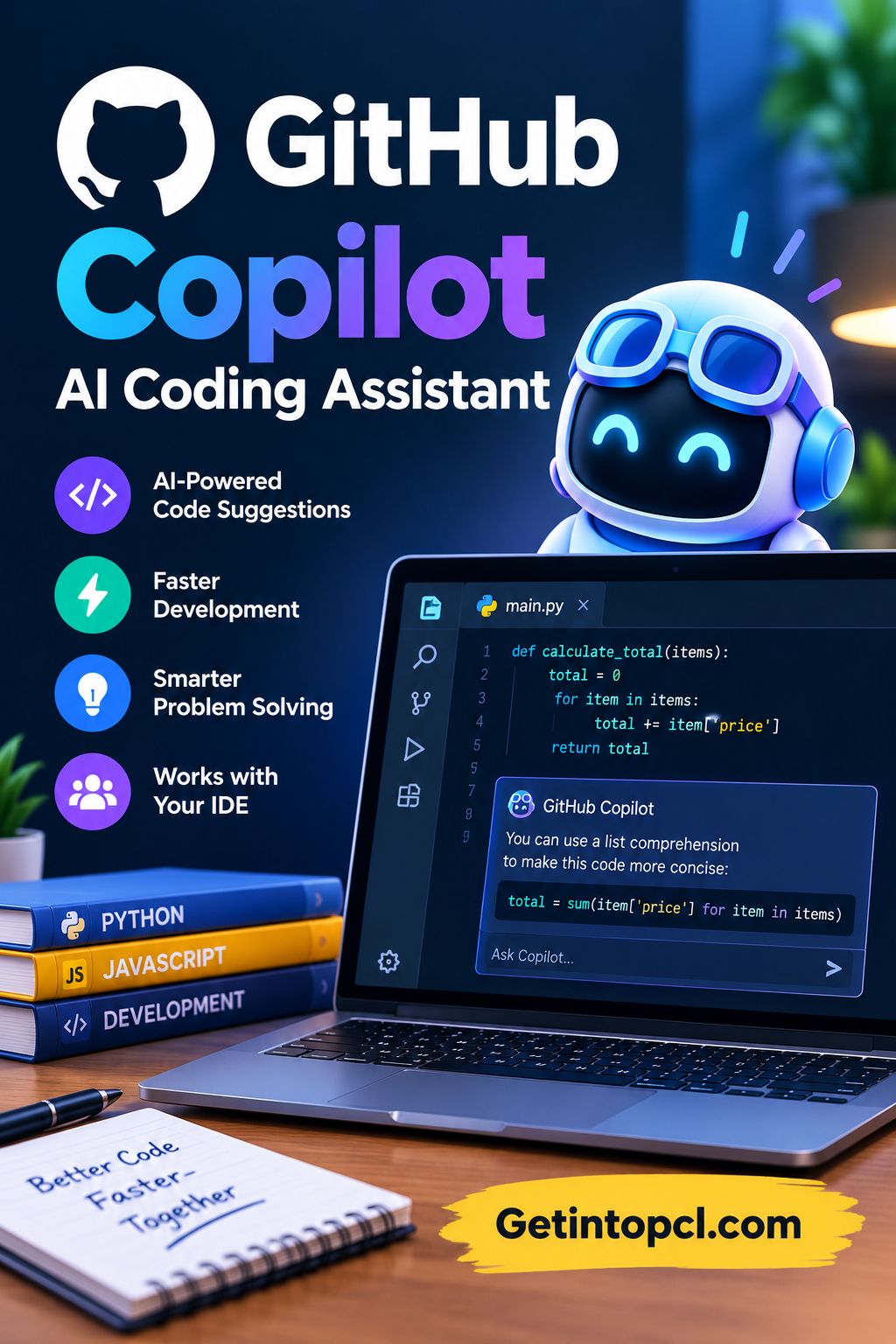
What Is GitHub Copilot?
GitHub Copilot is a generative AI assistant for software development. It can suggest code while a developer types, answer programming questions, generate or modify code, help investigate problems, and support larger development tasks through agentic features.
The assistant is available through supported IDEs, GitHub.com, GitHub Mobile, the command line, and other supported development environments. GitHub describes Copilot as a tool that combines code completion and conversational assistance with increasingly capable agent-based workflows.
Copilot is primarily cloud-connected AI software. The development environment contains the Copilot extension or integration, while AI processing takes place through GitHub’s supported services and models. It is therefore different from a completely offline local AI coding assistant.
GitHub Copilot can be used for many stages of software development, including:
- Writing new code
- Completing code while typing
- Explaining existing code
- Debugging
- Refactoring
- Writing tests
- Creating documentation
- Reviewing code
- Exploring repositories
- Planning implementation tasks
- Performing multi-file development tasks
- Working with supported AI agents
The exact capabilities available depend on the plan, IDE, model, and feature being used. GitHub’s feature matrix is updated as support changes.
Main Uses of GitHub Copilot
AI Code Completion
Code completion is one of GitHub Copilot’s foundational features. As developers type, Copilot can suggest the next portion of code, ranging from individual lines to larger blocks.
This can reduce repetitive typing when implementing common programming patterns, functions, configuration, or boilerplate code.
Copilot supports code completion across several development environments, including Visual Studio Code, Visual Studio, JetBrains IDEs, Eclipse, Xcode, and Neovim, although specific features differ between environments.
Code Generation
Developers can describe a programming task in natural language and ask Copilot to generate code.
For example, a developer might ask for a function that validates user input, processes a dataset, creates an API request, or converts data between formats.
Generated code should still be reviewed, tested, and adapted to the requirements of the project.
Understanding Existing Code
Copilot can explain code and answer questions about a development project.
This can help when working with:
- Unfamiliar repositories
- Legacy code
- New programming languages
- Complex functions
- APIs and libraries
- Large project structures
Workspace indexing and code-referencing features are available in several supported IDEs, allowing Copilot to work with broader project context.
Debugging
Developers can use Copilot Chat to investigate programming errors and ask for explanations or possible fixes.
A developer can provide an error message, selected code, or relevant project context and ask Copilot to explain what may be causing the problem.
The resulting suggestions should be checked against the actual application because AI-generated debugging advice can contain mistakes.
Testing
Copilot can help developers create tests for functions and other code.
It can suggest test cases, generate test implementations, and assist with modifying tests when application code changes.
For larger development tasks, agent mode can also incorporate testing into a broader workflow.
Code Review
GitHub Copilot includes AI-assisted code review features on supported plans and environments. Copilot can analyze code changes and identify potential issues or areas that deserve developer attention.
Code review is particularly relevant for teams that want AI assistance before merging changes, although human review remains important for security, architecture, business requirements, and correctness.
Agentic Software Development
One of the major developments in Copilot is its move beyond traditional autocomplete toward agentic coding.
Agent mode can work through more complex development requests, including analyzing a project, planning changes, editing files, and working through multiple steps.
GitHub also provides a cloud agent for supported paid plans. This allows certain development tasks to be delegated to an agent that works with a repository and produces changes for developer review.
Features
AI Code Completions
Copilot provides real-time code suggestions while developers type. Paid plans currently provide unlimited code completion, while Copilot Free is limited to 2,000 completions per month.
Copilot Chat
Copilot Chat provides a conversational interface for programming questions, explanations, debugging, code generation, and development guidance.
It is available in supported IDEs and on GitHub, with functionality varying by environment and plan.
Agent Mode
Agent mode allows Copilot to work on more complicated coding requests rather than simply returning a text response.
Current GitHub documentation lists agent mode support in Visual Studio Code, Visual Studio, JetBrains IDEs, Eclipse, and Xcode.
Cloud Agent
Copilot’s cloud agent can work on development tasks within GitHub’s environment. It is available on supported paid plans and is intended for more substantial coding workflows.
Next Edit Suggestions
Copilot can suggest subsequent edits based on the changes a developer is making. This feature is supported in several IDEs, with availability varying according to the environment.
Code Review
Copilot provides AI-assisted code review on supported plans and environments, helping developers identify potential issues in code changes.
MCP Support
GitHub Copilot supports the Model Context Protocol (MCP) in supported environments. MCP allows compatible tools and external services to provide additional context and capabilities to AI assistants.
Custom Instructions and Agents
Developers can provide custom instructions that tell Copilot about preferred coding styles, programming languages, response formats, or project conventions.
GitHub also supports custom agents in supported environments.
Multiple AI Models
GitHub Copilot provides access to different AI models depending on the subscription and feature. Paid plans provide broader model-selection capabilities, while Copilot Free uses automatic model selection.
The available model catalog can change over time as GitHub adds, removes, or updates supported models.
Platform and Compatibility
GitHub Copilot is available across a wide range of development environments.
| Environment | Copilot Support |
|---|---|
| Visual Studio Code | Yes |
| Visual Studio | Yes |
| JetBrains IDEs | Yes |
| Eclipse | Yes |
| Xcode | Yes |
| Neovim | Yes |
| GitHub.com | Yes |
| GitHub Mobile | Yes |
| GitHub CLI | Yes |
| Windows Terminal Canary | Copilot Chat integration |
GitHub’s current feature matrix shows that feature availability differs by IDE. For example, code completion is supported in all the listed environments, while agent mode, chat, code review, MCP, and workspace indexing have different support levels.
Supported JetBrains environments include IDEs such as IntelliJ IDEA, PyCharm, WebStorm, PhpStorm, GoLand, CLion, Rider, RubyMine, and others.
Copilot is not a traditional standalone Windows, macOS, or Linux desktop application. Instead, it integrates with supported development environments and GitHub services.
System Requirements
GitHub Copilot does not have one universal CPU, RAM, storage, or GPU requirement because it operates through different IDEs, GitHub services, and command-line environments.
The practical requirements depend largely on the development environment being used.
For example, someone using Copilot in Visual Studio Code must meet the system requirements of the supported VS Code version, while someone using Copilot in Visual Studio or a JetBrains IDE must meet that IDE’s requirements.
Generally, users need:
- A supported development environment
- A compatible Copilot extension, plugin, or integration
- A GitHub account
- Internet connectivity for Copilot’s cloud-based AI services
- Sufficient resources to run the selected IDE or development environment
A dedicated GPU is not specified as a universal requirement for GitHub Copilot.
Because GitHub’s supported environments and features can change, users should check the current Copilot documentation and their chosen IDE’s requirements rather than relying on generic hardware specifications.
Technical Setup Details
Setting up GitHub Copilot is relatively straightforward for an individual developer.
A typical IDE setup involves:
- Create or sign in to a GitHub account.
- Choose Copilot Free or an appropriate paid plan.
- Install the official GitHub Copilot extension or plugin for the selected IDE.
- Authenticate with GitHub.
- Open a software project.
- Enable the desired Copilot features.
- Start using code completion, chat, or other available capabilities.
GitHub currently allows most individual developers to start with Copilot Free, which provides limited code completions and AI functionality without requiring a paid plan.
For teams, administrators can assign Copilot Business or Enterprise seats and configure organizational policies and access controls.
Developers should also review Copilot’s privacy and organizational settings when working with proprietary source code.
Programming Languages
GitHub Copilot has been trained on code from public repositories across many programming languages. GitHub notes that the quality of suggestions can vary depending on the amount and diversity of public code available for a particular language.
Commonly used languages include:
- Python
- JavaScript
- TypeScript
- Java
- C#
- C++
- C
- Go
- Ruby
- PHP
- Rust
- Kotlin
- Swift
- SQL
- HTML
- CSS
The actual quality and feature availability can vary according to language, model, IDE, and Copilot feature.
Pricing and Licensing
GitHub currently offers several Copilot plans for individuals and organizations.
| Plan | Current price | Key information |
|---|---|---|
| Copilot Free | $0 | 2,000 completions/month and limited chat/agent usage |
| Copilot Pro | $10/month | Higher limits, model selection, agents and code review |
| Copilot Pro+ | $39/month | Higher AI-credit allowance and premium models |
| Copilot Max | $100/month | Highest individual AI-credit allowance and priority access |
| Copilot Business | $19/user/month | Organization management, governance and pooled credits |
| Copilot Enterprise | $39/user/month | Enterprise features and larger AI-credit allowance |
These are the current prices listed by GitHub and can change over time.
Copilot Free is a genuine free plan rather than simply a short trial. GitHub currently provides 2,000 code completions per month along with limited access to chat and agent features.
Paid plans use GitHub AI Credits for several AI-powered features. GitHub defines one AI credit as $0.01 USD for usage and explains that consumption varies according to the model and complexity of the interaction.
Code completions and next-edit suggestions are not charged against AI credits and remain unlimited on paid individual plans.
Advantages and Limitations
Advantages
- Integrates directly with popular development environments.
- Provides real-time code completion.
- Supports AI chat for programming questions.
- Provides agent mode for more complex coding tasks.
- Offers cloud-based coding agents on supported plans.
- Includes AI-assisted code review.
- Supports GitHub CLI and GitHub Mobile.
- Provides MCP support in supported environments.
- Offers multiple subscription levels.
- Provides a free plan for individual developers.
- Integrates naturally with the GitHub development ecosystem.
Limitations
- Copilot depends on cloud-connected AI services rather than functioning as a completely offline local AI assistant.
- The free plan has usage limits.
- Advanced models and features require paid plans.
- AI-generated code can contain errors or security problems and requires review.
- Feature availability varies considerably between IDEs.
- AI-credit usage can vary according to the model and complexity of requests.
- Some advanced agentic workflows can consume substantially more AI usage than simple code completion.
Who Should Use GitHub Copilot?
Software developers can use Copilot for everyday programming, code completion, debugging, refactoring, and testing.
Programming students can use it to explore programming concepts, ask questions about code, and experiment with different implementations. Students who qualify for GitHub’s verified student program can receive access through the Copilot Student offering.
Freelance developers can use Copilot inside their existing IDE instead of maintaining a separate AI coding workflow.
Open-source developers can use Copilot while working on public repositories, subject to the applicable GitHub plan and policies.
Development teams can use Copilot Business or Enterprise for centralized administration, policies, and organizational controls.
Experienced developers can also use its agentic features for larger multi-file development tasks rather than limiting AI assistance to autocomplete.
GitHub Copilot Alternatives
GitHub Copilot belongs to a rapidly growing category of AI development tools.
Amazon Q Developer combines AI coding assistance with strong integration into AWS development and cloud workflows.
Tabnine provides AI code completion, chat, testing, code review, and agentic development, with a particular emphasis on enterprise privacy and deployment options.
Cursor combines AI coding functionality with a dedicated code editor based on the VS Code ecosystem.
Google Gemini Code Assist provides AI coding assistance within Google’s developer and cloud ecosystem.
Claude Code focuses heavily on agentic software development and repository-level coding workflows.
The main difference is often the surrounding ecosystem. GitHub Copilot is deeply integrated with GitHub repositories, GitHub.com, GitHub Mobile, supported IDEs, GitHub CLI, and GitHub’s broader developer platform.
Download, Installation, or Access
GitHub Copilot is accessed through GitHub and supported development environments rather than through an unofficial standalone installer.
For individual developers, the basic process is:
- Create or sign in to a GitHub account.
- Start with Copilot Free or select a paid plan.
- Install the official Copilot extension for your IDE.
- Sign in through GitHub.
- Open a project and begin using Copilot.
GitHub provides official setup instructions for individuals and supports Copilot through multiple development environments.
Official GitHub Copilot: GitHub Copilot
Official Copilot Plans & Pricing: GitHub Copilot Plans and Pricing
Users should install Copilot through GitHub or the official extension/plugin marketplace for their development environment rather than using modified or unauthorized copies.
Frequently Asked Questions
Is GitHub Copilot free?
Yes. GitHub currently offers Copilot Free at no cost to eligible individual developers. It includes up to 2,000 code completions per month and limited access to chat and agent features.
Does GitHub Copilot work with VS Code?
Yes. Visual Studio Code is one of the primary development environments supported by GitHub Copilot. It supports features including code completion, chat, agent mode, workspace indexing, MCP, code review, and custom instructions, although individual features can change over time.
Can GitHub Copilot write code?
Yes. Copilot can generate code from natural-language instructions, provide inline suggestions, modify existing code, and support larger agentic coding tasks.
Can GitHub Copilot debug code?
Yes. Developers can use Copilot Chat and related coding features to investigate errors, explain problems, and suggest changes. AI-generated fixes should be tested before being incorporated into production software.
Does GitHub Copilot work offline?
GitHub Copilot is not designed as a completely offline local AI coding assistant. Its AI services depend on network connectivity to GitHub’s supported services.
Does GitHub Copilot support Python?
Yes. Python is among the programming languages supported by GitHub Copilot. GitHub states that Copilot is trained across languages represented in public repositories, although suggestion quality can vary according to the available training data for each language.
Is GitHub Copilot suitable for students?
Yes. Students can use Copilot for programming assistance, and verified students may qualify for the Copilot Student offering. GitHub currently lists Copilot Student as a free plan for verified students.
Does GitHub Copilot replace a programmer?
Copilot is designed as an AI development assistant rather than a replacement for developer judgment. Developers remain responsible for reviewing generated code, testing changes, checking security implications, and ensuring that implementations meet project requirements.
Conclusion
GitHub Copilot is an AI coding assistant for code generation, completion, explanation, testing, review, and agentic software development. Its biggest distinction is its close integration with the GitHub ecosystem and popular development environments.
The platform has evolved beyond traditional autocomplete. Developers can now use Copilot Chat, agent mode, cloud-based coding agents, code review, MCP integrations, custom instructions, workspace context, and multiple AI models depending on their plan and environment.
For individual users, Copilot Free provides a way to try AI-assisted programming without a paid subscription, with current limits of 2,000 code completions per month and limited AI-credit-based features. Paid plans provide higher usage allowances and access to additional models and capabilities.
For developers searching for an AI programming assistant, AI code completion tool, AI developer software, code generation assistant, or agentic coding platform, GitHub Copilot offers a broad set of development features across VS Code, Visual Studio, JetBrains IDEs, Eclipse, Xcode, Neovim, GitHub, and command-line workflows.
As with any generative AI development tool, Copilot works best as an assistant: generated code should be reviewed, tested, and evaluated for correctness, security, licensing, and suitability before being used in a real project.